
Where Fairfield Previous Residents Surface
Previous residents of a Fairfield address appear in separate layers. The recorder is strongest for ownership and encumbrances. Reverse directories and census schedules are stronger for dated households. Permits show work and project participants. Obituaries, cemetery records, and probate can explain a person’s later trail. Start with the era and question, not with the largest database.
| Source | Years or cutoff | Where held | What it shows |
|---|---|---|---|
| Solano recorded documents | Microfilm from 1848; computer images from 1955; web earliest year unstated | Recorder index, counter, microfilm | Grantor, grantee, transfers, liens, legal description |
| Verified regional directories | 1871–72, 1874, 1878–79, 1884–85, 1904–05 | SCGS and UC Davis | Names, occupations, post-office clues, regional context |
| Fairfield-Suisun directories and phone books | Exact runs pending catalog confirmation | Library and SCGS | Later names, addresses, and possible reverse evidence |
| Federal census | 1850–1950 public under the 72-year rule | NARA, library databases, archives | Named households at decennial snapshots |
| Building permits | Exact online cutoff not located | Fairfield Building Safety or county | Work dates, applicants, contractors, and project history |
| Obituaries and probate | Publication or filing date | Library, court, cemetery, newspaper | Family, prior places, heirs, and trail endpoints |
For an address today, begin with APN and legal description. For an early owner, begin with the recorder and deed books. For a former household, pair a directory or census clue with the property chain. Exact gaps in directory, Sanborn, and permit coverage remain gaps, not invitations to guess.
Use Fairfield Recorder Records for Previous Residents
The Solano Recorder Online Index is free metadata, not a complete image library. Simple Search accepts free text, and the official FAQ gives the example JOHN DOE 2014; Advanced Search can narrow grantor or grantee, recording date, document number, and document description. Results show document number, recording date, page count, title or description, and party names. Street address is not a searchable result field.
Office computers show images from 1955 forward and microfilm reaches 1848. Copies are ordered at the counter or by mail. A mail request identifies the parties, recording date, document number or book and page, telephone, fee, and requested certification. The researched schedule lists $9 for the first page, $1 for each added page, and $6 for certification, subject to current office confirmation.
The Recorder search FAQ supplies the documented query details behind the image.
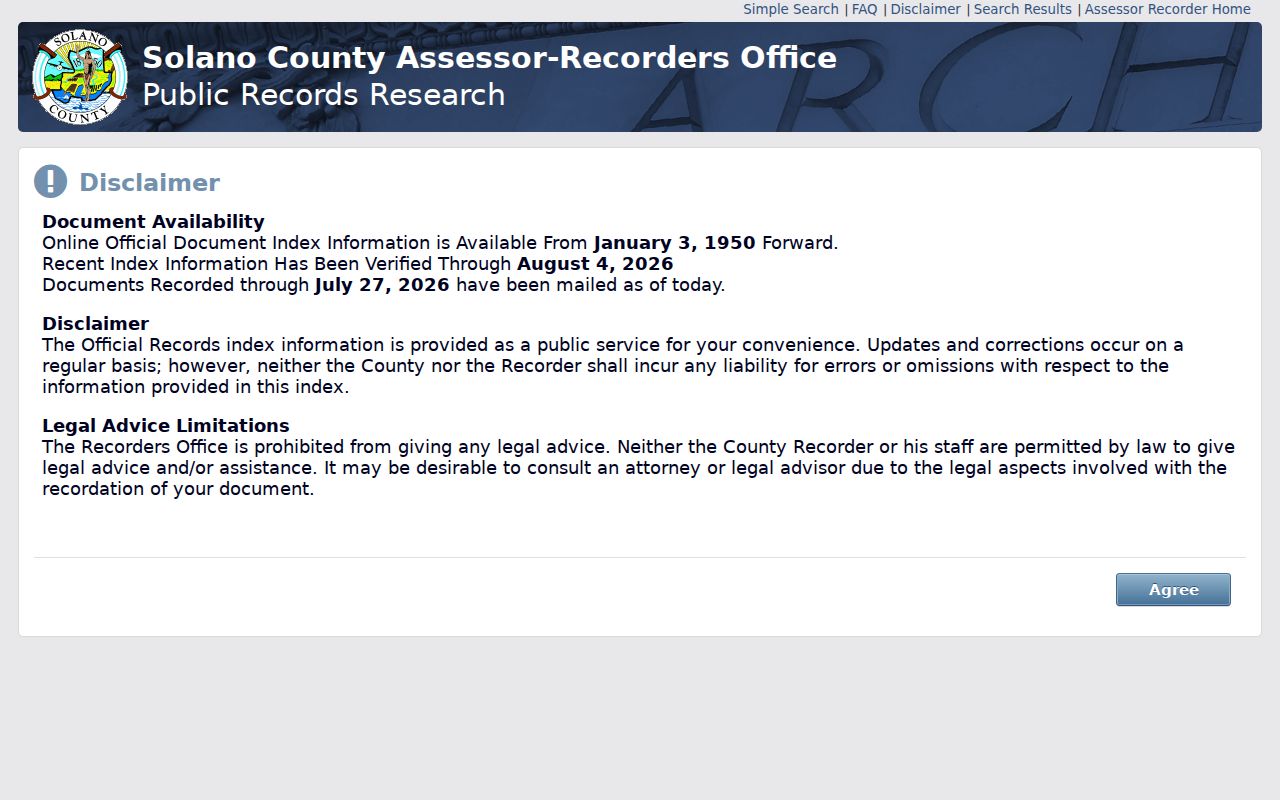
The live Recorder Online entry point is the place to begin a name, date, document-number, or description search before moving to the counter.
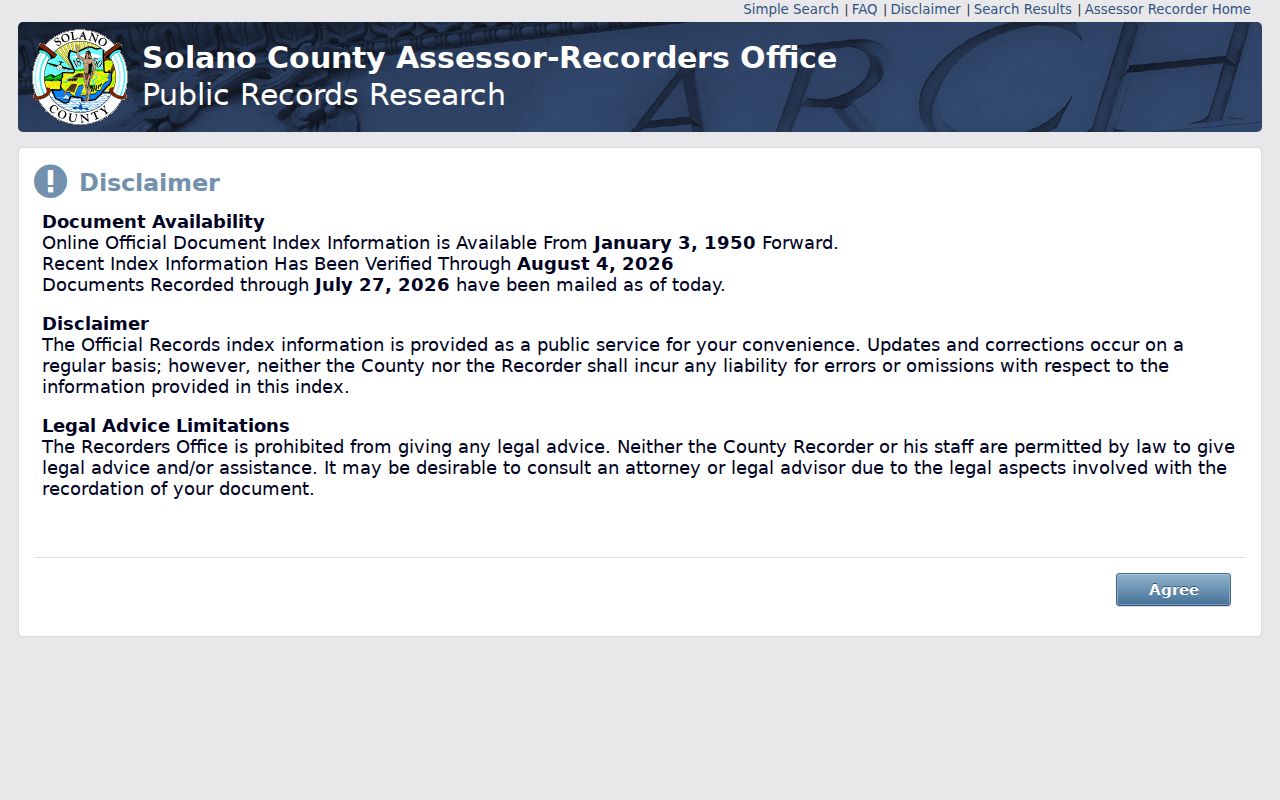
When the web index ends, move to the office counter, grantor-grantee books, deed books, and microfilm. The oldest searchable year is not stated for the web index, so do not print an invented online cutoff.
Fairfield Previous Residents: House History Needs the APN
The APN and legal description are the continuity keys for previous residents of a Fairfield property. A situs street label can change, a mailing address can point elsewhere, and a regional directory can call the same area Suisun or Fairfield. Compare subdivision, lot, block, map, and legal-description language before joining two records.
A quitclaim may change vesting without a market sale. A deed of trust secures a loan. A reconveyance releases it. A trustee’s deed can reflect foreclosure. An affidavit of death, probate order, distribution deed, or trust transfer may mark an estate or family transition. Read the document image before simplifying the chain to “sold from A to B.”
Fairfield’s 1942 air base growth and 1966 Travis annexation also matter. Address labels and jurisdictions can change even when the land history continues. Keep the date, APN, legal description, and custodian beside each entry.
Fairfield Previous Residents on the County-Seat Trail
Solano County was one of California’s original 27 counties, created in 1850. Fairfield later became the county seat after Benicia, so early deeds, probate, court minutes, tax books, and marriage records for a wider Solano area can now lead back to Fairfield counters. A 19th-century property trail may therefore be filed under a county or handwritten party book rather than a modern city street.
Fairfield’s official history dates the town layout to Captain Robert H. Waterman in 1856, the county-seat move to a voter decision in November 1858, the brick courthouse and jail to 1860, and incorporation to 1903. These milestones help frame a prior-resident search: early downtown history may require deed books, newspapers, probate, and directories, while later subdivisions are easier to anchor with APNs, maps, permits, and telephone books.
Use the historical story to choose the next shelf, not to fill an absent record with a name.
Walk Back Through Deeds of Fairfield Previous Residents
The deed chain is the clearest route to previous owners of a Fairfield address, but only when the land is matched at each step. Begin with the current public assessor record and its APN or legal description. Then move from a current grantee to the prior grantor, and from that grantor to an earlier grantee. Keep trusts, estates, quitclaims, liens, and reconveyances in their own category.
- Normalize the address with USPS and locate the parcel in Solano GIS.
- Write down the APN, situs, legal description, public owner field, and tax mailing destination.
- Search the Recorder for the current owner as grantee and compare the document image or description to the parcel.
- Record the seller or grantor, recording date, document number, and legal description.
- Search that grantor as an earlier grantee, repeat while the APN or legal description continues to match, and move to counter books or microfilm when the online route ends.
- Grantor
- The person or entity giving, transferring, or encumbering an interest.
- Grantee
- The person or entity receiving an interest in the recorded instrument.
- Chain of title
- The linked sequence of recorded interests used to explain how a parcel moved through time.
- Legal description
- The formal land description that can preserve continuity when a street number or name changes.
The chain identifies past owners, not necessarily previous residents. Occupants may be family members, renters, caretakers, or people omitted from public directories. That is why the deed trail must be paired with a household source.
Pair Fairfield City Directory Years With Census
The library and SCGS hold the household layer that deeds cannot supply. The verified regional titles include 1871–72, 1874, 1878–79, 1884–85, and the 1904–05 Kingsbury volume. Later Fairfield-Suisun directories and phone books are confirmed as holdings, but exact public runs remain to be checked with staff. A gap in the catalog is not a date.
The 1950 federal census is the newest public schedule in 2026 under the National Archives’ 72-year rule. Pair a directory issue with the nearest census rather than treating either as a live source. Compare name, occupation, relatives, post-office clue, address, and enumeration district. An entry disappearing can mean a move, death, unlisted telephone, changed surname, or missing publication.
The National Archives census research page is the release and access reference for that historical comparison.
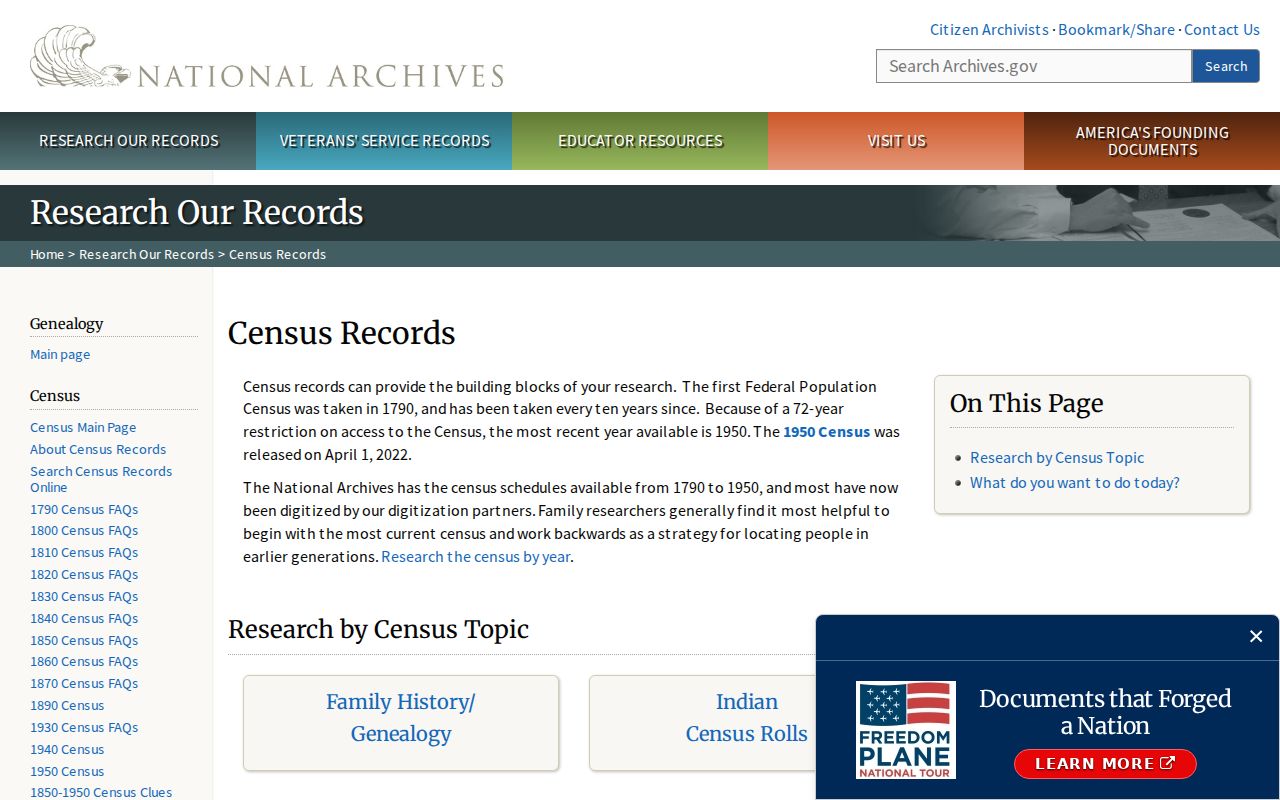
For a historical address, preserve the enumeration district or page reference when available. It makes a later comparison to a directory, map, obituary, or deed much easier.
Let Fairfield Permit Dates Frame Previous Residents
Fairfield BUILD replaced TRAKiT on April 22, 2025 and transferred active and historical permit, plan, and project data according to the city. A permit can show when a building, addition, demolition, reroof, or utility project was filed, inspected, or finalized. The public record may name an owner, applicant, designer, or contractor. Those names are project participants, not automatic previous residents.
Sanborn fire-insurance maps can help date footprints, use, and old numbering when the relevant Fairfield sheets and years are confirmed through a library or repository. The supplied research did not verify the exact Fairfield Sanborn run, so the map source should be treated as a future catalog check, not a guessed date. The same caution applies to an exact permit digitization cutoff.
When a street number changes, compare the legal description, subdivision, lot, block, APN, map sheet, and neighboring parcels. A new number without those anchors can create a false chain of previous residents.
Fairfield Past Residents Need Two Sources
Previous residents are more likely to appear in a directory, census, obituary, cemetery record, or probate file than in a deed. The Fairfield city directory collections page explains the volumes themselves. For a house-history project, borrow the relevant entry, pair it with the matching census decade, and use the deed chain only to keep the land identity straight.
The Solano County Library obituary and newspaper request service searches an exact event date through the following two weeks. It accepts the requester, event, date, name, city or location, and helpful details. A free emailed PDF can preserve a family clue. The Solano County Genealogical Society also holds cemetery transcriptions and local indexes. Probate can add public petitions, notices, orders, heirs, and distribution deeds, but addresses may be stale or redacted.

The request form asks for the event type, exact event date, name, city or location, and other helpful details. That specificity matters in Fairfield, where a notice may use Fairfield, Suisun City, Travis, or another Solano place label. An emailed PDF can preserve the wording without turning a family notice into a current address claim.
Lawful use. Fairfield previous-resident research is for house history, family history, and personal curiosity. Do not use a past address or living person’s record to stalk, harass, track, or intimidate anyone.
A responsible conclusion says “the directory places this household at the address in a given year” or “the deed identifies this owner,” then names the next record needed. It does not claim a complete list of everyone who lived there.
Fairfield and Suisun labels should remain side by side in the worksheet. A regional title, newspaper, cemetery, or school source may use Suisun for a Fairfield-area family. The legal parcel and dated source decide whether the clue belongs in the address history. That small habit prevents a regional place name from becoming a false move.